ADDICTION: THE UNSPOKEN TRUTH
ADDICTION: THE UNSPOKEN TRUTH
I’ve lost two little brothers to overdose.
Fentanyl. Opiates. Addiction.
I spent a lot of my life trying to help them, understand them, save them — while struggling with my own addictions at the same time.
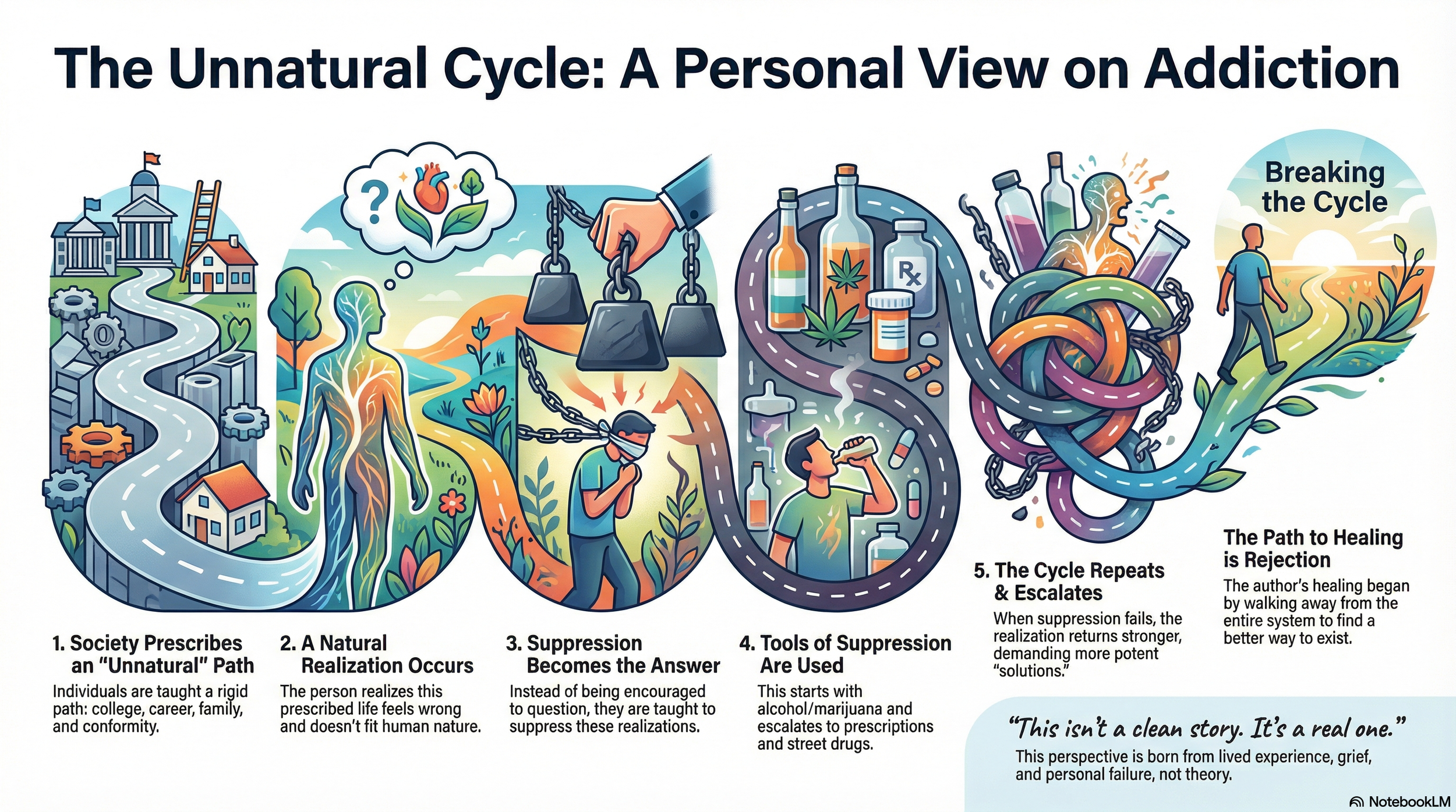
I have been an addict since childhood. Not because I was broken, but because addiction was what I was taught — by adults, by institutions, by society itself.
It started with being taught to live unnaturally.
Succeed.
Go to college.
Start a business.
Have a family.
Do what you’re told and call it fulfillment.
Early on, I realized something was wrong with that path. It didn’t fit reality. It didn’t fit human nature. But instead of being encouraged to question it, I was taught to suppress those realizations.
Alcohol was the first obvious suppression tool. It was everywhere. It’s what the adults around me used to dull their own realizations. Then marijuana — not because it was better, but because it became available, accepted, even promoted as a healthier escape.
Then came the diagnoses.
Depression — a natural response to living an unnatural and unachievable life.
ADHD — a reaction to being trapped in an education system with no substance, no meaning, no engagement.
Anger — the result of understanding things clearly while being told I was stupid for not conforming.
Therapy followed, and the blame was placed squarely on me. Prescription drugs came next — drugs no child or human should be on — not to heal, but to enforce conformity.
That led to cocaine and other street drugs, because that’s how people around me coped with the same realizations, disbeliefs, and loss of natural instincts and autonomy.
It became a cycle that lasted decades:
Realization.
Suppression.
Alcohol.
Marijuana.
Therapy-induced coping.
Prescription drugs.
Failure of obvious outcomes.
More realization.
More suppression.
Over and over.
It wasn’t until I walked away from all of it — in search of a better way to exist — that I was able to strip these addictions out of my life.
That matters, because what I’m about to say doesn’t come from theory, textbooks, or treatment pamphlets.
It comes from watching people I love suffer.
From failing repeatedly.
From sitting with grief that doesn’t resolve cleanly.
From slowly realizing that the way we talk about addiction misses something fundamental.
This isn’t a clean story.
It’s a real one.
The Lie About Addiction
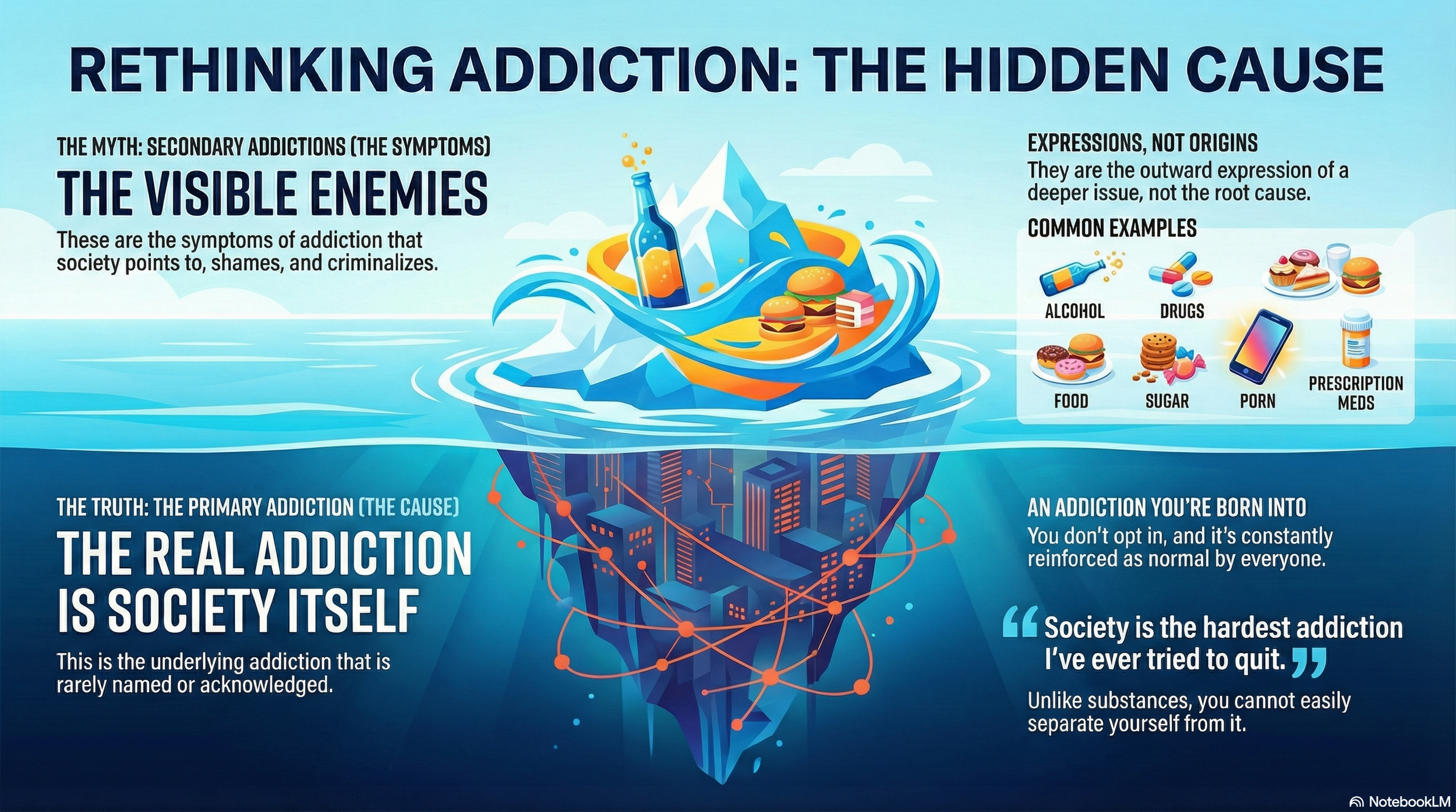
We’re taught that addiction is a substance problem.
Alcohol.
Drugs.
Porn.
Food.
Sugar.
Prescription meds.
These are the visible enemies — the things society can point at, regulate, medicate, shame, or criminalize.
But that framing is incomplete.
Those are secondary addictions. They are expressions, not origins. Symptoms, not causes.
The primary addiction — the one no one wants to name — is society itself.
Society is the hardest addiction I’ve ever tried to quit, because unlike substances, you’re born into it. You don’t opt in. You don’t see it clearly. And everyone around you reinforces it as normal.
Society as the Root Addiction
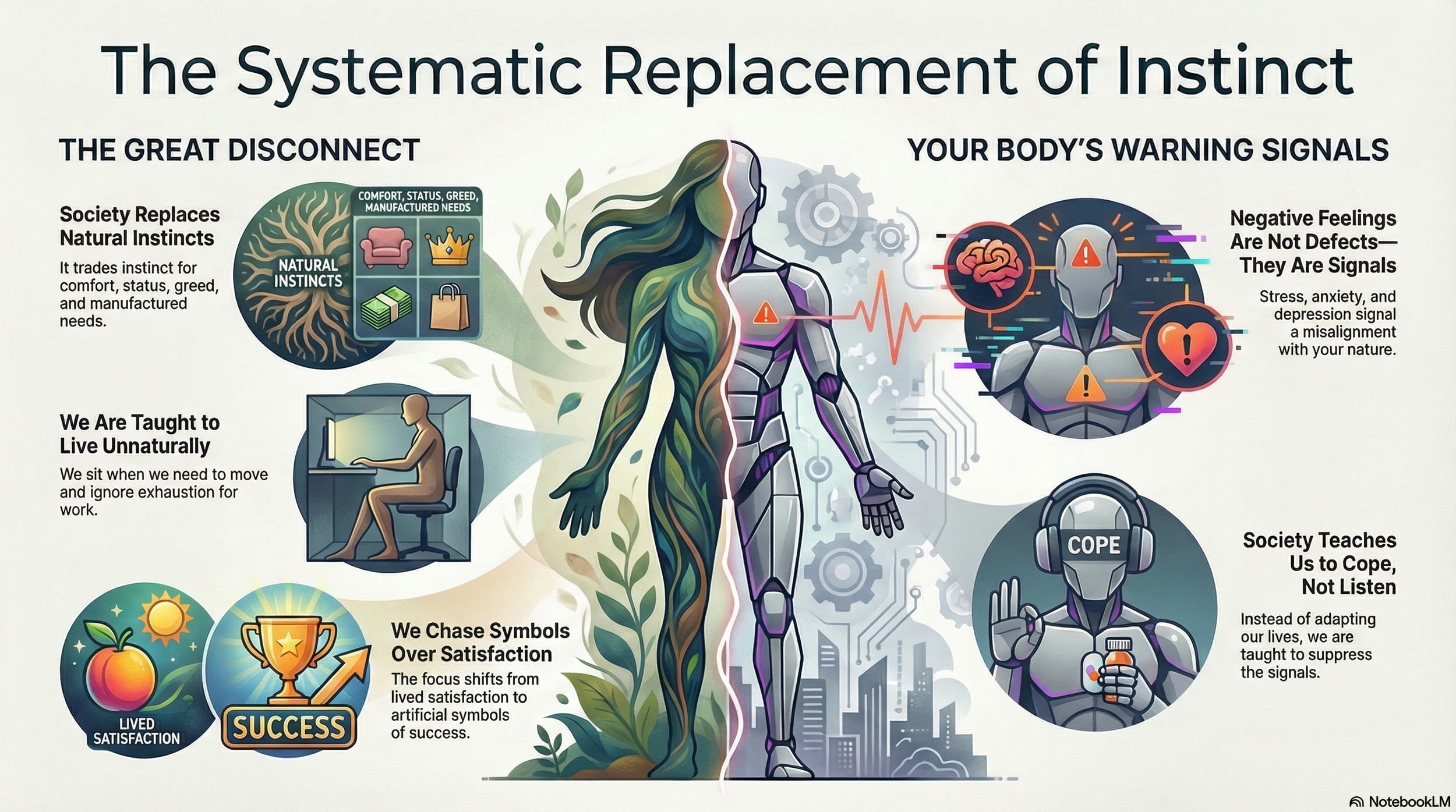
Society trains humans to live unnaturally.
Not maliciously — but systematically.
It strips us of natural instincts, natural behaviors, natural rhythms, and natural feedback loops.
And replaces them with comfort, convenience, status, greed, artificial success, and manufactured needs.
We’re taught to sit when our bodies want to move.
To ignore hunger and exhaustion when work demands otherwise.
To suppress emotion when it’s inconvenient.
To chase symbols of success instead of lived satisfaction.
When your body and mind react negatively to this — stress, anxiety, depression, anger, numbness — those reactions are not defects.
They are signals.
Signals that something about how you’re living is misaligned with how humans evolved to function.
But instead of teaching people to listen to those signals and adapt their lives, society teaches us something else.
It teaches us to cope.
Coping Is the Gateway Drug
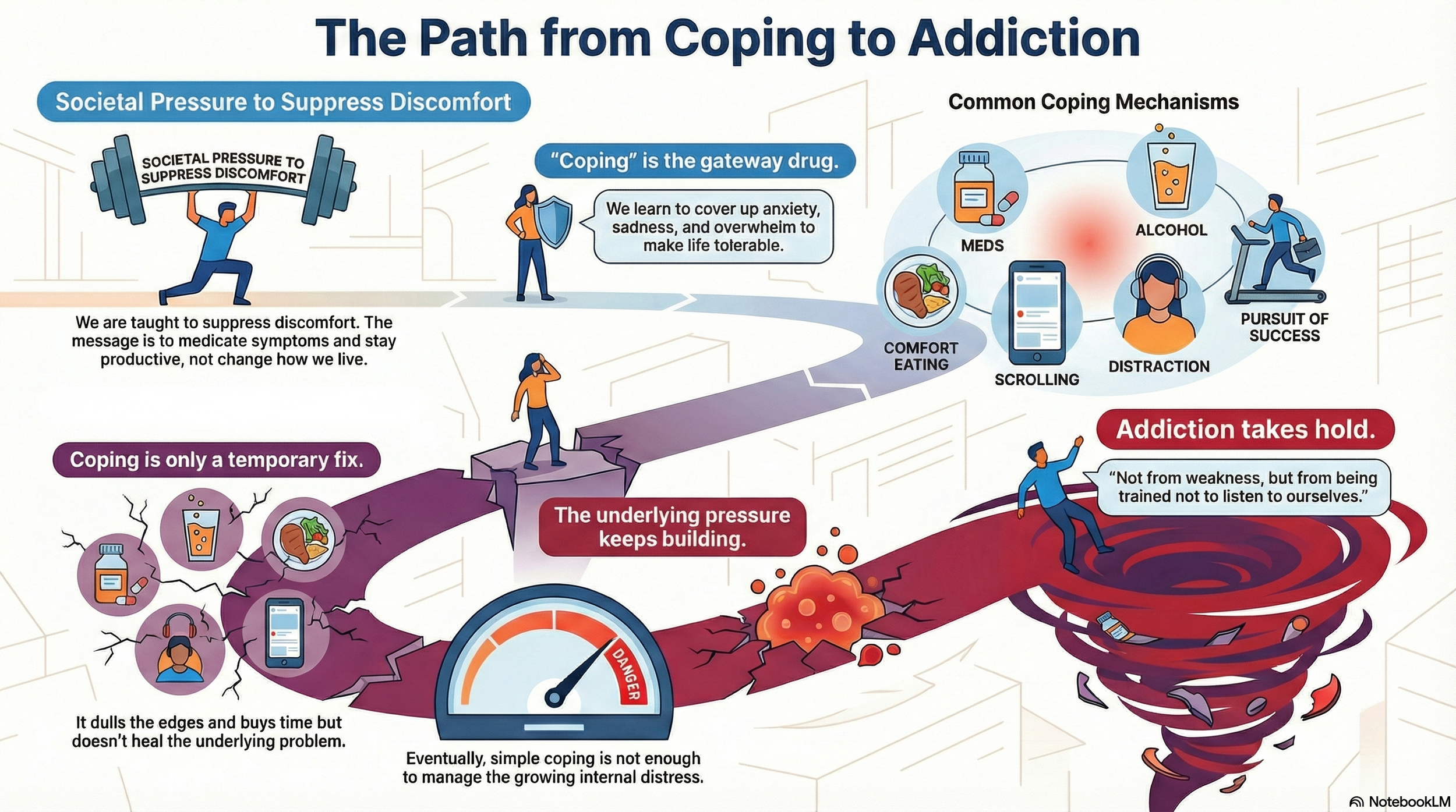
From a young age, we are taught to suppress discomfort, normalize misery, medicate symptoms, drown out internal signals, push through, and stay productive.
If you’re anxious, tired, angry, sad, disconnected, or overwhelmed, the message isn’t to change how you’re living.
The message is to make it tolerable.
So we cover it up.
With pills.
With alcohol.
With weed.
With porn.
With food.
With scrolling.
With distraction disguised as entertainment.
With success itself.
At first, coping works. It dulls the edges. It buys time.
But coping doesn’t heal anything. It only postpones reckoning.
Eventually, coping stops being enough — because the underlying pressure keeps building.
That’s where addiction takes hold.
Not because people are weak.
Not because they’re immoral.
But because they were trained not to listen to themselves.
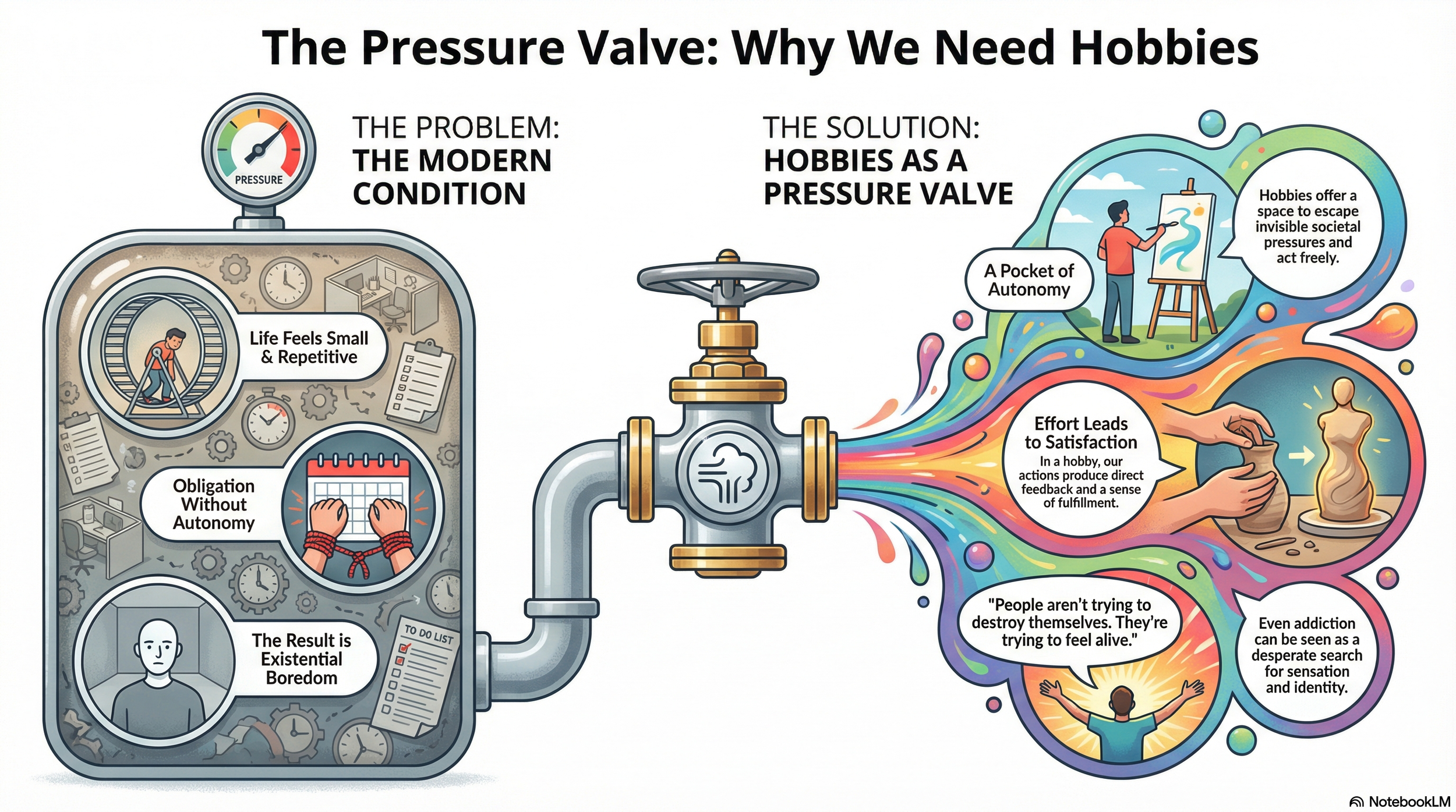
Why We Need Hobbies at All
Here’s the missing piece.
The lives most people are offered by modern society are small, repetitive, and emotionally dead.
They’re minute.
They’re boring.
They lack substance.
They’re lives we wouldn’t wish on our enemies — yet we live them anyway.
Not because they’re fulfilling, but because there is a constant, invisible pressure to conform to them.
Most people feel it.
Few can name it.
Almost no one can escape it cleanly.
Endless work that doesn’t matter.
Schedules that don’t match the body.
Rules without meaning.
Obligation without autonomy.
Very little feedback.
Very little fulfillment.
So people become emotionally disengaged from real life.
They’re bored — not casually bored, but existentially bored.
And because most people can’t leave the system — financially, socially, legally, or psychologically — they look for relief inside it.
That’s where hobbies come in.
A hobby is a pressure valve.
A pocket of autonomy.
A place where effort leads to feedback.
Where action produces satisfaction.
Addiction is simply the cheapest, fastest, and most available hobby society offers.
It requires no permission.
It provides immediate sensation.
It creates routine and identity.
People aren’t trying to destroy themselves.
They’re trying to feel alive.
What I Learned Quitting Over and Over
I’ve quit many addictions in my life. Some more than once.
And the realization that changed everything was this:
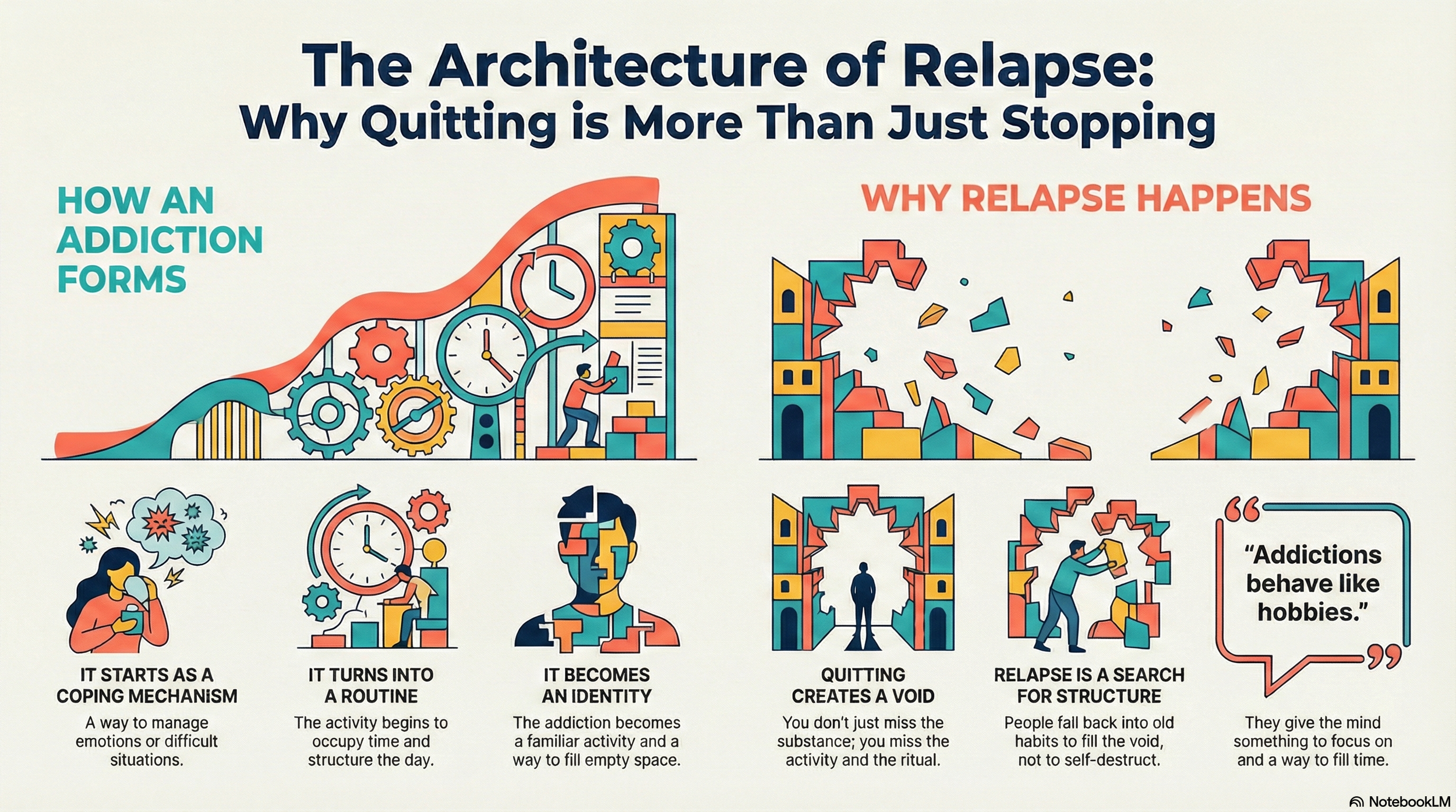
Addictions behave like hobbies.
They start as coping mechanisms.
They turn into routines.
They become something you do.
They occupy time.
They structure days.
They give the mind something to focus on.
So when you quit, you don’t just miss the substance.
You miss the activity.
The ritual.
The identity.
The way it filled empty space.
That’s why people relapse.
Not because they want to self-destruct — but because they removed structure and replaced it with nothing.
Addiction Is a Bad Hobby
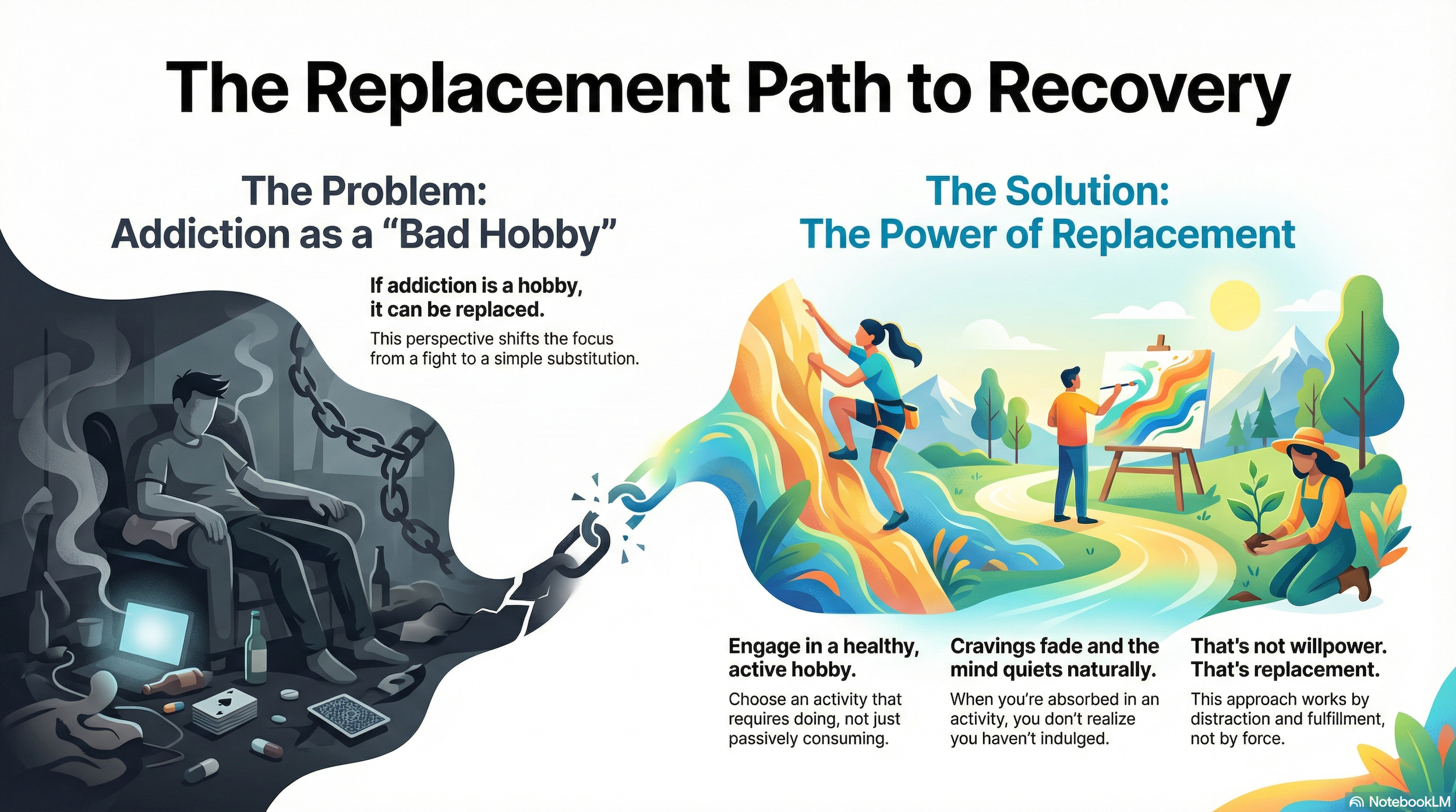
If addiction is a hobby, then it can be replaced.
When you’re deeply engaged in a healthy hobby — actively doing, not passively consuming — cravings fade. Time passes. The body feels used instead of restless. The mind quiets naturally.
Hours go by.
And then you realize:
You didn’t drink.
You didn’t smoke.
You didn’t binge.
You didn’t escape.
That’s not willpower.
That’s replacement.
Good Hobbies vs Bad Hobbies
Bad hobbies promise relief without effort and deliver emptiness with interest.
Good hobbies use effort to create satisfaction.
Movement.
Making things.
Fixing things.
Writing.
Drawing.
Music.
Walking.
Training.
Craft.
Skill-building.
Quiet repetition.
Learning slowly.
Even good hobbies can become excessive.
Moderation applies to everything.
There is no perfect solution — only healthier direction.
Addiction Is Not Just Substances
Once you see addiction clearly, you see it everywhere.
People are addicted to relationships, chaos, drama, politics, ideologies, religion, success, attention, validation.
Society encourages these addictions because they are profitable and controllable.
An addicted population is easier to manage than a fulfilled one.
Why This Matters
Most addiction treatment removes the substance without addressing the environment that made it necessary.
That’s why relapse rates are high.
You can’t remove the coping mechanism and leave the wound untouched.
You can’t heal addiction without changing how you live.
What I Believe Now
Addiction is not moral failure.
Addiction is not weakness.
Addiction is not stupidity.
Addiction is what happens when humans are trapped in unnatural systems and taught to ignore their own signals.
I don’t think everyone needs rehab.
I think many people need purpose, physical engagement, simpler lives, fewer illusions, real feedback, and honest reflection.
Alignment — not escape.
Why I’m Sharing This
I couldn’t save my brothers.
That’s something I carry.
But if any part of this helps someone understand themselves more clearly, then it matters.
This isn’t advice.
This isn’t instruction.
This isn’t a program.
It’s lived understanding.
Take what helps.
Leave what doesn’t.
And don’t turn it into ideology.